Program type
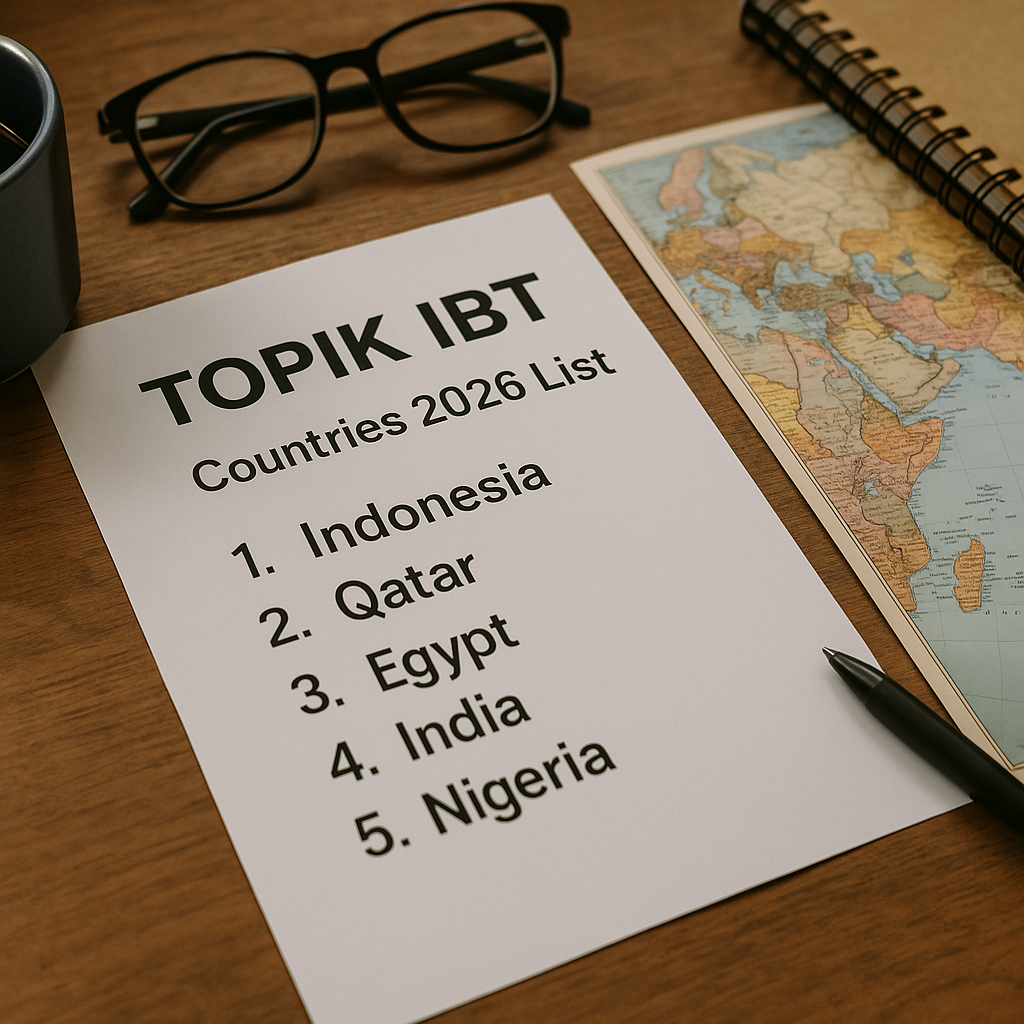
The TOPIK IBT new countries 2026 list matters because internet-based TOPIK (Test of Proficiency in Korean) access can differ from the paper-based test and may change by administration. For international-school applicants, short-term academic participants, and learners planning study or work in Korea, the practical issue is whether a nearby test center is officially open for the selected session.
TOPIK IBT is a computer-delivered Korean language examination. It is not an international school course or a university admission program by itself; rather, it is an assessment that may be used as supporting evidence of Korean ability. A country should be treated as part of the 2026 expansion only when the relevant official registration notice identifies its test location, session, and application channel.
Eligibility
Eligibility is determined by the examination notice and the local administering institution. Applicants normally need an accepted identity document, a usable email address, and the ability to complete the registration process within the stated period, while local requirements may also cover payment, photographs, or document formats.
Students joining an international-school pathway or a short-term academic program should check whether the institution needs a particular TOPIK level, a result issued by a specific session, or evidence of Korean study instead. A test center appearing in an informal country list does not guarantee that its result will meet a school, employer, or visa-related requirement.
- Identity: confirm that the name on the application matches the identification document used at the test center.
- Location: verify the city, venue, local time, and whether the center accepts applicants residing outside the country.
- Level: check whether the destination program requests TOPIK I, TOPIK II, or a specified score.
- Deadline: allow time for payment confirmation and any correction period shown in the official notice.
Curriculum or activities
TOPIK IBT does not provide a curriculum in the way a language school does. Preparation generally covers listening, reading, and writing tasks appropriate to the selected examination level, with additional practice for keyboard input, on-screen navigation, and the timing of a computer-based session.
Participants in Korea-focused academic programs can connect test preparation with daily study activities. Korean reading assignments, classroom vocabulary, guided speaking practice, and cultural orientation may support broader Language development, although only the examination authority can define the tested content and scoring method.
- Before registration: review the level, format, sample tasks, identification rules, and technical requirements.
- During preparation: practice Korean input methods and complete timed reading and listening exercises on a computer.
- For academic planning: compare the expected result date with school enrollment, exchange, or short-term program deadlines.
Dates and costs
There is no single worldwide date or fee for every newly added country. Registration windows, examination sessions, local currency charges, payment methods, and result-release schedules must be taken from the notice issued for the selected center in 2026.
| Item | What to verify | Why it matters |
|---|---|---|
| Registration | Opening and closing times in local time | International applicants may otherwise miss the window. |
| Test session | Date, check-in time, and venue address | IBT centers may have different schedules by country. |
| Fee | Amount, currency, tax, and payment channel | Bank or card charges may not be included in the published fee. |
| Results | Expected announcement and score-use deadline | Programs may require results before enrollment or application review. |
Budget planning should include possible travel to the approved center, document preparation, and a second attempt if the result is below the target. Do not rely on a fee copied from another country, because local administration arrangements can produce different charges.
Application
The safest application route is the registration link named in the official notice for the selected session. Applicants should save the confirmation page, payment receipt, registration number, and any instructions concerning identity checks or computer testing.
For learners who are also exploring professional opportunities, Korean study may be paired with Networking activities and an Internship search, but these are separate from TOPIK registration. Employment information can be reviewed through the Ministry of Employment and Labor at MOEL, while recruitment listings should be assessed independently through Recruitment resources.
- Identify the country and city shown in the official 2026 session notice.
- Read the applicant, identity, technical, and payment conditions before submitting details.
- Use the designated registration channel rather than an unverified intermediary.
- Check the confirmation record and contact the local center promptly if information is incorrect.
Accreditation checks
TOPIK is an examination result, not an accreditation of an international school, private academy, internship provider, or short-term program. A school may accept a TOPIK score for placement or admission, but acceptance policies differ and should be confirmed directly with the institution without assuming official affiliation.
Applicants can separate three checks: whether the test center is authorized for the session, whether the score report is valid, and whether the receiving institution accepts that result. HRD Korea, available through its English information site at HRD Korea, is a Korean public employment and skills-development authority; its information may be useful for employment-related context, but it should not be treated as proof that every private program or test center is accredited.
| Check | Evidence to request |
|---|---|
| Test authorization | Official session notice naming the country, center, and application route. |
| Score validity | Recognized result record or verification method identified by the examination authority. |
| Program acceptance | Written admissions or placement guidance from the receiving school or program. |
| Provider status | Business, institutional, or government registration information where relevant. |
Official program source
The 2026 country list should be checked against current Korean public notices rather than social-media graphics or agency summaries. The Ministry of Employment and Labor and HRD Korea are appropriate Korean government sources for employment, skills, and related planning context, but the specific TOPIK IBT country, center, schedule, and fee must be confirmed through the examination authority or the local institution named in the official registration notice.
Editorial note: a country is not confirmed for a 2026 TOPIK IBT session unless an official notice provides enough information to identify the test center and application process. Availability can be session-specific, so applicants should recheck the notice before paying or arranging travel.
For international schools and short-term academic programs in Korea, the result is best used as one part of an application file. Compare the requested Korean level, the result deadline, and the institution’s own admissions rules, then keep copies of all official instructions used during registration.
자주 묻는 질문 (FAQ)
Is there one confirmed TOPIK IBT new-country list for 2026?
Availability can vary by session. Confirm each country and test center in the official 2026 registration notice before applying.
Does TOPIK IBT replace an international-school admission process?
No. It is a Korean-language proficiency assessment. Each school or short-term program decides whether and how it accepts the result.
Where should applicants verify dates and fees?
Use the official notice and the registration channel named for the selected country and session. Local fees and deadlines may differ.
Can HRD Korea confirm a TOPIK IBT test center?
HRD Korea is useful for Korean employment and skills information, but test-center authorization should be confirmed through the examination authority or named local administering institution.
Get in Touch
Have questions about your specific situation? Reach out anytime for a personal consultation.
Email: editor@sis-korea.com